


AI writing tools draft, edit and optimize faster than ever — but every one produces a first draft, not a finished piece. Here are the best tools by use case and how to use them well.
| Drafts In Seconds From A Prompt | Assistant, Not Author Editing Required | A Tool Per Task Pick By Use Case | Fact-Check It AI Can Invent | Your Voice Wins Make It Yours |
| Quick answer: The best AI writing tools depend on the task. The versatile baseline is a general assistant — ChatGPT, Claude or Gemini — which handles most writing. Add a specialist only for a specific gap: Jasper for marketing brand voice, Grammarly for editing, Writesonic or Surfer for SEO, Sudowrite for fiction. The most important thing to know is that every tool produces a first draft, not a finished piece — human editing, fact-checking and original insight are still required. (Claude is made by Anthropic, the maker of this assistant.) |
Key Takeaways
- A general assistant is the baseline — ChatGPT, Claude or Gemini covers most writing needs.
- Specialists earn their cost only for gaps — brand voice, SEO, fiction or workspace integration.
- Every output is a first draft — editing, fact-checking and your own voice are non-negotiable.
- AI invents facts — verify names, numbers, quotes and sources before publishing.
Table of Contents
1. AI Writing Tools: An Overview
AI writing tools have exploded in number, but the category has settled into a clear shape. The versatile baseline is the general-purpose assistants — ChatGPT, Claude and Gemini — which now handle the majority of everyday writing tasks. Around them sits a layer of specialized tools that earn their place only when they add something the base models lack: brand-voice enforcement, SEO optimization, dedicated editing, or fiction-specific generation.
The single most important thing to understand is that every one of these tools produces a first draft, not a finished piece. Independent testing consistently finds that the bulk of AI-generated content needs heavy editing to sound authentic and accurate. This guide maps the categories, the best tools for each, and how to get genuinely good results. AI writing tools are among the most useful AI tools for business and a core part of the wider world of generative AI tools for content creation.
It’s worth knowing how quickly this market has shaken out. Many early tools were thin wrappers around a single model, and as the general assistants absorbed their core features, a wave of them shut down or pivoted to other businesses. The survivors are the ones that built something defensible — a fiction-tuned model, deep SEO data, real brand-voice controls — which is a useful filter when deciding what is actually worth paying for.
2. The Main Types of AI Writing Tools
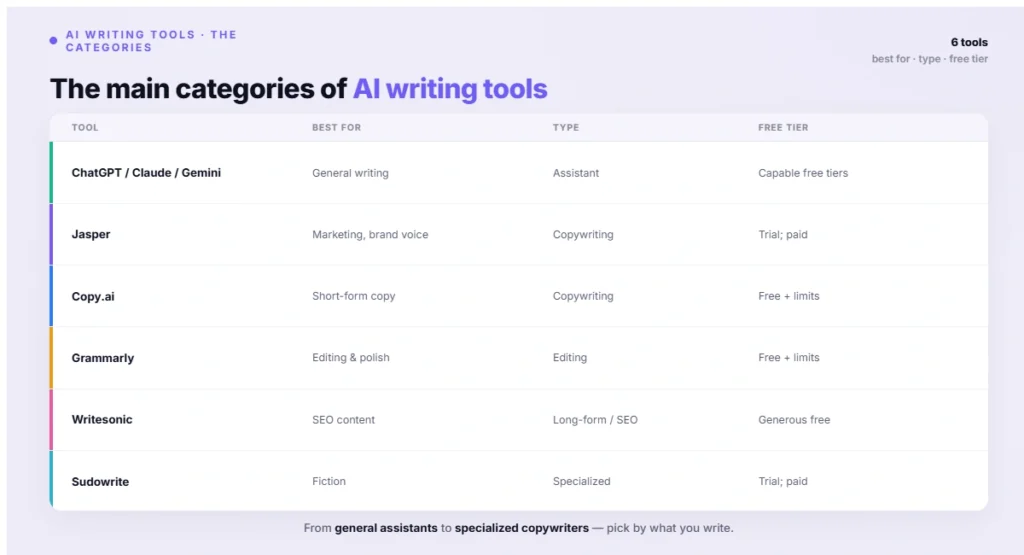
It helps to think in categories. General-purpose assistants — ChatGPT, the most versatile with the largest ecosystem; Claude, often cited for prose quality and long-form writing like essays and reports; and Gemini, integrated with Google’s apps — are the flexible baseline for brainstorming, drafting and almost any format. Copywriting tools like Jasper and Copy.ai add templates, brand voice and marketing workflows on top of a model.
From there the categories narrow. Long-form and SEO tools such as Writesonic, Surfer and Frase combine writing with keyword and content optimization. Grammar and editing tools like Grammarly polish what you’ve already written rather than generate from scratch. Specialized tools serve niches — Sudowrite for fiction, QuillBot for paraphrasing — and research tools like Perplexity add live search with citations. As the figure shows, the trick is matching the category to the job rather than expecting one tool to do everything well. (Claude is made by Anthropic, the maker of this assistant.)
One distinction cuts across all these categories: generation versus editing. Generation tools write from a prompt, while editing tools improve text you already have, and the two are complementary rather than competing. A common and effective setup pairs a strong generation tool with a dedicated editing layer, so you get capable drafting and reliable polish without forcing a single tool to do both jobs only adequately.
The main categories of AI writing tools.
3. The Best AI Writing Tools
For most people, a general assistant is the place to start. ChatGPT is the most versatile all-rounder and excellent for brainstorming and first drafts; Claude is frequently praised for the quality of its prose and long-form writing; and Gemini is a strong choice if you live in Google’s apps. One of these, paired with an editing layer, replaces most standalone tools for individual use. For marketing teams, Jasper (at jasper.ai) is the cleanest pick when brand-voice consistency across channels matters.
Copy.ai (at copy.ai) focuses on short-form conversion copy and sales workflows, while Grammarly (at grammarly.com) is the editing and polish layer — grammar, rewriting and plagiarism checks — best paired with any generation tool. For search-driven content, Writesonic and Surfer add SEO intelligence, and for storytelling, Sudowrite is the rare tool built specifically for fiction. The table summarizes the fit; verify pricing, since it changes often.
A recurring piece of advice from people who test these tools for a living is to resist buying a specialist too early. Most teams haven’t come close to exhausting what a general assistant can do before reaching for a pricier dedicated tool, and the specialized option is often less flexible in return. The cost-effective stack for many writers is simply a general assistant plus an editing tool, adding a focused tool only once a clear, repeated need actually appears.
| Tool | Best for | Type | Free tier (verify) |
|---|---|---|---|
| ChatGPT / Claude / Gemini | General writing | Assistant | Capable free tiers |
| Jasper | Marketing, brand voice | Copywriting | Trial; paid |
| Copy.ai | Short-form copy | Copywriting | Free + limits |
| Grammarly | Editing & polish | Editing | Free + limits |
| Writesonic | SEO content | Long-form/SEO | Generous free |
| Sudowrite | Fiction | Specialized | Trial; paid |
4. What to Look For
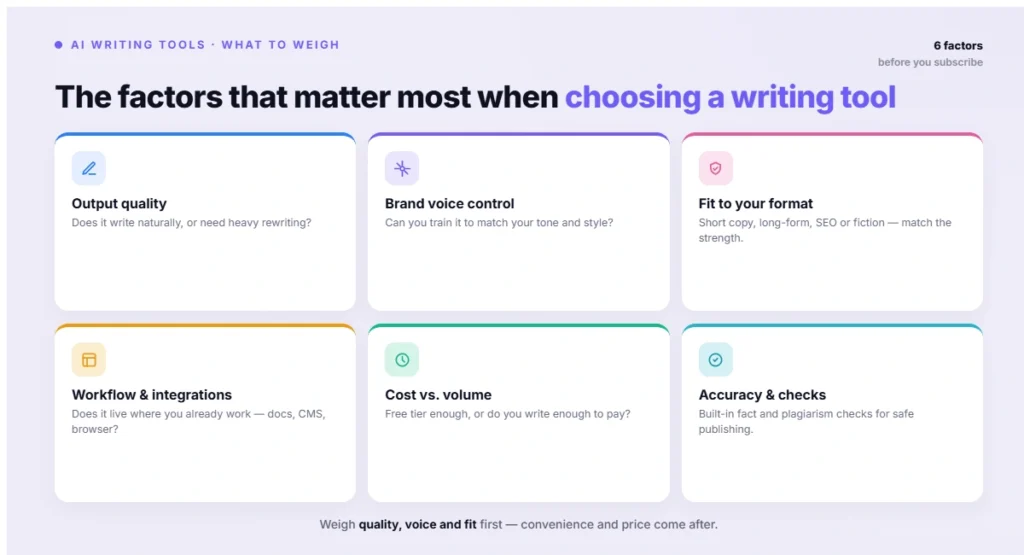
The top factor is output quality, and the real cost to weigh is total editing time, not the sticker price — a tool that drafts well saves far more than a cheap one whose output needs rewriting. Just behind it is use-case fit: the best tool for marketing copy is not the best for fiction or SEO, so define what you actually write before choosing. A general tool that’s strong everywhere often beats a specialist you’ll rarely use.
After those, editing and control — brand voice, tone settings and the ability to refine output — determine how usable a draft is, and integrations with your docs, CMS or workspace decide whether it fits your workflow. Finally, compare price and limits, remembering that a general assistant plus an editing tool like Grammarly covers most needs. As the figure shows, you should only pay for a specialist that fills a specific gap the base models leave open.
It’s also worth testing a tool on your own real work before committing, because demos and marketing samples are chosen to flatter. Run a few genuine tasks through the free tier, then judge it on how much editing the output actually needs rather than how impressive the first sentence looks. The tool that quietly saves you the most editing time is usually the right one, regardless of how long its feature list runs.
The factors that matter most when choosing a writing tool.
5. Pricing: Best AI Writing Tools 2026
| Tool | Best For | Key Features | Pricing | Ease of Use |
|---|---|---|---|---|
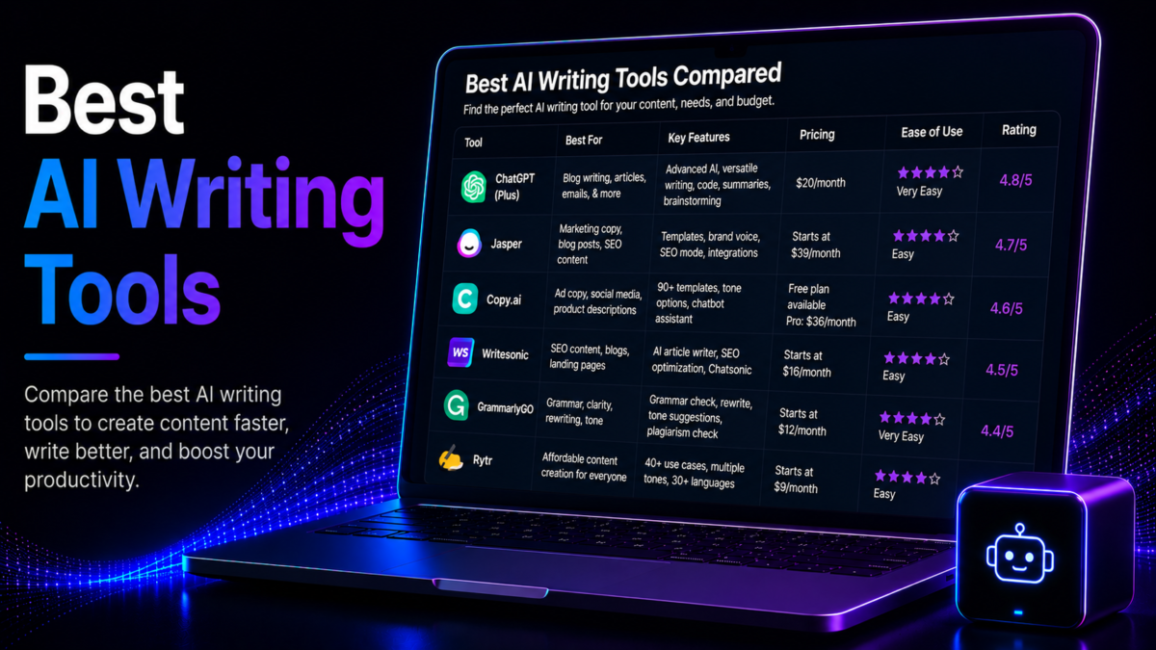
| ChatGPT (Plus) | Blog writing, articles, emails & more | Advanced AI, versatile writing, code, summaries, brainstorming | $20/month | ⭐⭐⭐⭐⭐ Very Easy |
| Jasper | Marketing copy, blog posts, SEO content | Templates, brand voice, SEO mode, integrations | Starts at $39/month | ⭐⭐⭐⭐ Easy |
| Copy.ai | Ad copy, social media, product descriptions | 90+ templates, tone options, chatbot assistant | Free plan; Pro $36/month | ⭐⭐⭐⭐⭐ Easy |
| Writesonic | SEO content, blogs, landing pages | AI article writer, SEO tools | Starts at $19/month | ⭐⭐⭐⭐ Easy |
| Grammarly | Editing & polish | Grammar, tone, clarity checks | Free plan; Premium $12/month | ⭐⭐⭐⭐⭐ Very Easy |
| Sudowrite | Fiction & creative writing | Story engine, brainstorming, style match | Trial; from $19/month | ⭐⭐⭐ Moderate |
For general writing, ChatGPT Plus offers the best all-around value at $20/month. Marketers needing brand consistency should choose Jasper, while budget users can start free with Copy.ai or Grammarly.
6. How to Get the Best Results
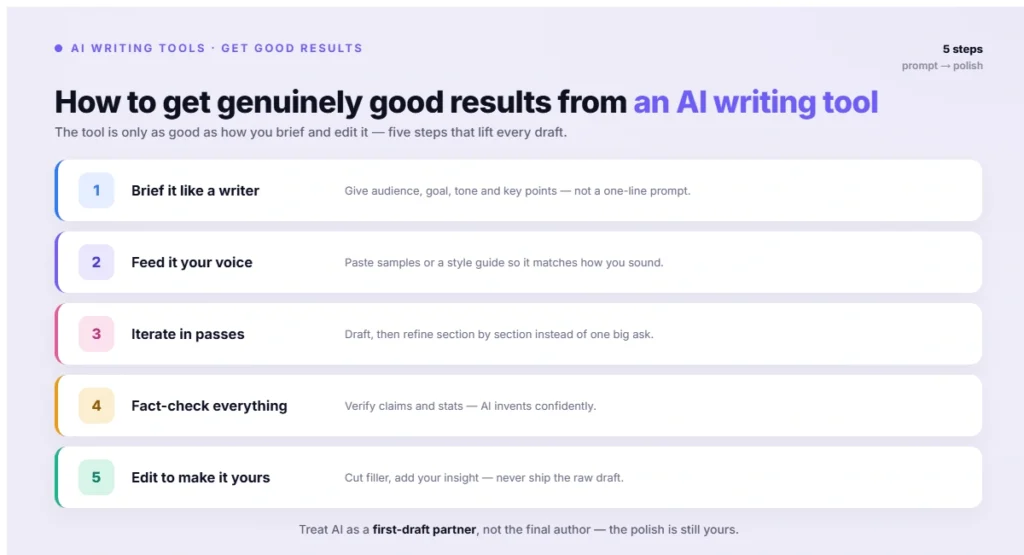
The biggest determinant of quality isn’t which tool you pick — it’s how you use it. Start with a clear, specific prompt: give the AI context, your audience and an example or two, because vague prompts produce exactly the generic output AI writing is criticized for. Strong prompting is a skill in itself, which is why prompt engineering matters so much. Then generate a draft and treat it strictly as a starting point.
The real work comes next. Edit the draft heavily — fix the structure, tighten the flow, and cut the padding — then fact-check everything, because AI confidently invents facts, quotes, statistics and sources. Finally, make it your own by adding your voice, expertise and perspective, the part no model can supply. As the figure shows, AI handles the research, structure and drafting; you add the insight that makes the piece worth reading. That division of labor — machine for speed, human for judgment — is how the best writers use these tools.
A few habits compound the benefit. Giving the model a role and a clear audience sharpens its tone; asking for an outline first lets you steer the structure before any prose exists; and iterating in steps — draft, critique, revise — beats hoping for a perfect one-shot answer. None of this is complicated, but it’s the difference between output that reads like a template and output that reads like you wrote it on a good day.
How to get genuinely good results from an AI writing tool.
7. Limitations & Using Them Responsibly
The honest limits are important. AI writing tools are assistants, not authors: testers consistently find that the majority of AI output needs substantial editing to sound authentic, and raw output is generic and repetitive. They also hallucinate — stating false facts and inventing quotes and sources with complete confidence — so fact-checking is non-negotiable, especially for names, numbers and citations. And because they’re trained on existing text, they can occasionally echo phrasing closely enough that important work is worth running through a plagiarism check.
On responsibility, follow any disclosure rules that apply to you, since some academic and professional contexts require revealing AI use — and don’t rely on AI content detectors to police it, because their accuracy is unreliable, just as the tools built to evade them, the AI humanizers, are imperfect too. The practical line is simple: used as a drafting partner under human direction, these tools are a real productivity gain; used to publish unedited, they produce the generic “AI slop” that readers and search engines alike ignore. The accuracy problem is the same one behind AI hallucinations everywhere.
There’s also a quieter risk worth naming: over-reliance. Leaning on these tools for every sentence can erode the writing and thinking skills that let you judge their output in the first place, and it tends to flatten everyone’s prose toward the same agreeable middle. Used deliberately — for drafts, structure and speed, with your own judgment firmly in charge — they make you faster without making your writing interchangeable with everyone else’s.
| ⚠️ Important AI writing tools are assistants, not authors — every output is a first draft that needs editing, fact-checking and your own voice. They hallucinate, inventing facts, quotes, statistics and sources with confidence, so verify everything before publishing. Because they’re trained on existing text, check originality on important work. Follow disclosure rules where they apply, and don’t rely on AI detection to enforce them, since detection is unreliable. Start with a general assistant plus an editing tool, and pay for a specialist only to fill a specific gap. Pricing changes quickly, so verify current plans. |
8. Frequently Asked Questions
What is the best AI writing tool?
It depends on the task. For general writing, the big assistants — ChatGPT, Claude and Gemini — are versatile and cover most needs. For marketing copy, Jasper and Copy.ai; for grammar and editing, Grammarly; for SEO content, Writesonic or Surfer; for fiction, Sudowrite. There’s no single winner — match the tool to what you write.
Are AI writing tools free?
Many offer free tiers. ChatGPT, Claude and Gemini all have capable free versions, and Grammarly, Copy.ai and Writesonic have free plans with limits. Dedicated tools like Jasper are usually paid. Free tiers are ideal for testing a tool on your own work before committing to a paid plan.
Can AI writing tools replace writers?
No. They’re assistants that speed up drafting and brainstorming, but they can’t supply original thinking, real expertise, genuine voice or verified facts. The best results come from a skilled writer directing and editing the tool, not from publishing raw AI output, which is typically generic and error-prone.
Is content from AI writing tools detectable?
Often, yes — AI detectors flag raw AI text, though imperfectly, and editing reduces detection. More importantly, follow any disclosure rules that apply to you, and remember that AI detection accuracy is itself unreliable, with real false-positive problems, as covered in our detector guides.
Do AI writing tools plagiarize?
They generate text rather than copy it, but they can occasionally reproduce phrasing from their training data or state facts incorrectly. For important content, run it through a plagiarism checker, verify the facts independently, and edit it into your own words and voice before publishing.
Are AI writing tools accurate?
Not reliably. They can state false facts with complete confidence — a problem known as hallucination — and invent quotes, statistics and sources. Always fact-check anything an AI writing tool produces before publishing, paying special attention to names, numbers, dates and citations, which are the most error-prone.
Which AI writing tool is best for SEO?
Tools like Writesonic, Surfer and Frase are built for SEO, combining writing with keyword and content optimization. General assistants can write SEO content too with good prompting. Whichever you use, human editing and genuine value matter most for ranking — search engines reward quality, not how content was made.
How do I get better results from AI writing tools?
Give clear, specific prompts with context and examples, generate a draft, then edit heavily for accuracy, voice and flow. Treat the output as a first draft to improve, fact-check everything, and add your own expertise. Good prompting plus real editing beats raw generation every time.
9. Conclusion & Key Takeaways
AI writing tools are a genuine productivity gain when used well. For most people, the smartest approach is to start with a general assistant — ChatGPT, Claude or Gemini — plus an editing tool like Grammarly, then add a specialist such as Jasper, Surfer or Sudowrite only when you hit a specific gap. But the principle underneath every choice is the same: these tools produce first drafts, not finished work. Direct them with clear prompts, edit heavily, fact-check relentlessly, and add the voice and expertise only you can bring. Do that, and AI handles the busywork while you produce something genuinely worth reading. Explore more in our guides to generative AI tools for content creation and the broader field of generative AI.
- A general assistant plus an editing tool covers most writing needs at low or no cost.
- Pay for a specialist only to fill a specific gap: brand voice, SEO, fiction or workspace.
- Every output is a first draft — edit, fact-check and add your own voice.
- AI hallucinates facts and sources, so verify everything before publishing.
- Quality comes from how you use the tool, not just which tool you pick.
The best AI writing tool won’t write for you — it’ll write with you, fast. Give it a clear brief, treat its draft as raw clay, and shape it with your own facts, voice and judgment. That partnership, not the tool alone, is what turns a generic draft into writing worth publishing.
