


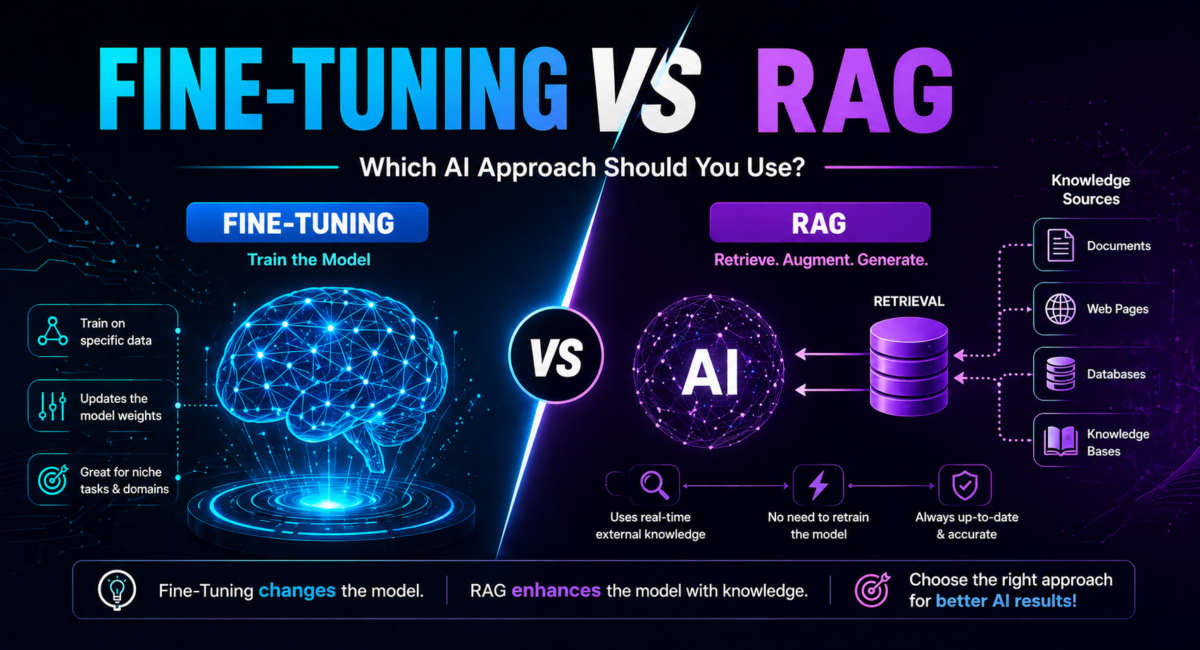
Fine-tuning vs RAG, explained — what each one is, how they differ, a head-to-head comparison, when to use each, and why hybrid systems are the production default.
| ~51% Enterprise AI Using RAG | 2 Core Customization Methods | 30–70% Hallucinations Cut by RAG | 3 Key Decision Factors | Hybrid 2026 Production Default |
| Quick answer: Fine-tuning and RAG are two ways to customize an LLM. RAG (retrieval-augmented generation) connects the model to an external knowledge base so it can look up facts in real time — best for fresh, changing information. Fine-tuning retrains the model’s weights on your data — best for consistent style, format and behavior. The rule of thumb: RAG keeps your system truthful; fine-tuning makes it consistent. In 2026, most production systems use a hybrid of both. |
Key Takeaways
- RAG and fine-tuning are the two main ways to customize an LLM — they solve different problems.
- RAG retrieves facts from an external knowledge base in real time (best for fresh, changing info); fine-tuning retrains model weights (best for consistent style, format and behavior).
- The rule: “RAG keeps your system truthful today; fine-tuning makes it consistent tomorrow” — put volatile knowledge in retrieval, stable behavior in fine-tuning.
- RAG is the practical default (~51% of enterprise deployments); hybrid is the 2026 production standard — but start with prompting first.
Table of Contents
1. Fine-Tuning vs RAG: The Quick Version
Out of the box, a large language model knows a lot in general but nothing about your specific business, documents or rules. There are two main ways to fix that: RAG and fine-tuning. They are often framed as rivals, but they actually solve different problems — and the most useful question is not “which is better?” but “where should my intelligence live: in external knowledge, in the model’s weights, or both?”
The cleanest way to remember the difference: RAG keeps your system truthful today; fine-tuning makes it consistent tomorrow. RAG gives the model access to current, specific facts by letting it look them up; fine-tuning bakes a consistent style, format or behavior into the model itself. Put volatile knowledge in retrieval, put stable behavior in fine-tuning, and stop trying to force one tool to do both jobs.
This guide explains each approach, compares them head-to-head, and gives a practical decision framework. Both are ways of customizing the models covered in our pillar guide to the best AI models, and both relate closely to reducing AI hallucinations. By the end you’ll be able to look at almost any AI customization problem and quickly tell whether it calls for retrieval, fine-tuning, both, or simply a better prompt — which is the single most useful judgment to have when building with AI.
2. What Is RAG?
Retrieval-augmented generation (RAG) connects an LLM to an external knowledge base — your documents, database or live data — so that when a query arrives, the system first retrieves relevant content and then generates an answer using both that content and the model’s own abilities. In effect, the model “looks up” the right information rather than relying on what it memorized during training. Nothing about the model’s weights changes; you simply control what’s in the knowledge base.
The big advantages are freshness and truthfulness. Because RAG pulls from a live source, it stays up to date without retraining, can cite the exact documents it used, and dramatically reduces hallucinations — grounding in retrieved evidence cuts hallucination rates by roughly 30–70%. It’s also relatively low-cost to start and easy to update (just change the documents). The main catch is that RAG is only as good as its retrieval and its data: poor retrieval or stale, ungoverned content feeds the model bad context and degrades answers.
A useful analogy: RAG is like giving the model an open-book exam. The model doesn’t need to have memorized your company handbook — it just needs to be handed the right page at the right moment. This is exactly why RAG is so well suited to knowledge that changes: when a policy updates or a new product launches, you simply update the document the model reads from, and the next answer reflects the change instantly, with no retraining. It’s also why transparency comes naturally — because the answer is built from specific retrieved passages, the system can show you which sources it used, letting you verify the response rather than trusting it blindly.
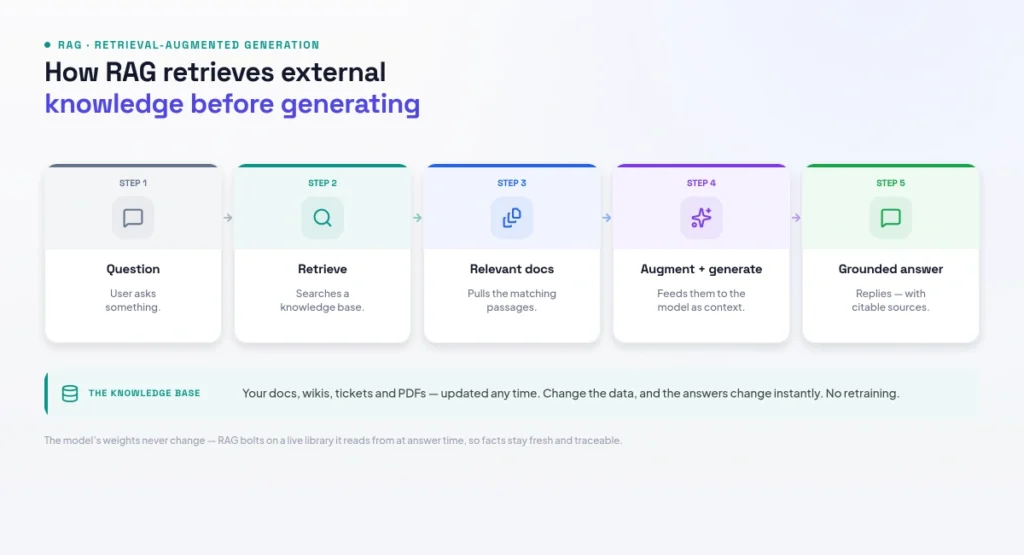
Figure 2: How RAG retrieves external knowledge before generating an answer
3. What Is Fine-Tuning?
Fine-tuning takes a pre-trained LLM and trains it further on your own curated dataset, actually modifying the model’s weights. Through this process the model internalizes your domain’s terminology, tone, formats and decision patterns, so it behaves the way you want without needing those instructions every time. Where RAG adds knowledge at query time, fine-tuning encodes behavior into the model itself.
Fine-tuning shines at consistency — reliable format, stable tone, strong classification, and adherence to specific policies or styles. For high-volume, narrow tasks, it can also be efficient once the upfront training cost is amortized. The trade-offs are real, though: it requires more compute and ML expertise, every knowledge update means retraining (so it’s poor for fast-changing facts), it risks “catastrophic forgetting” of general ability, and feeding proprietary data into training raises privacy considerations. In short, fine-tuning is powerful for behavior, weak for fresh facts.
To extend the exam analogy: if RAG is an open-book exam, fine-tuning is studying until the material becomes second nature. A fine-tuned model has internalized your patterns so deeply that it produces the right style and structure automatically, without being reminded each time — which is exactly what you want for tasks where the how matters more than the latest facts. Think of a model trained to always reply in your brand’s voice, to classify support tickets into your exact categories, or to format every output as a particular JSON schema. Those are stable behaviors worth baking in. The danger is using fine-tuning for the wrong job: bake in a fact and it’s frozen until you retrain, which is slow, costly, and brittle for anything that changes.
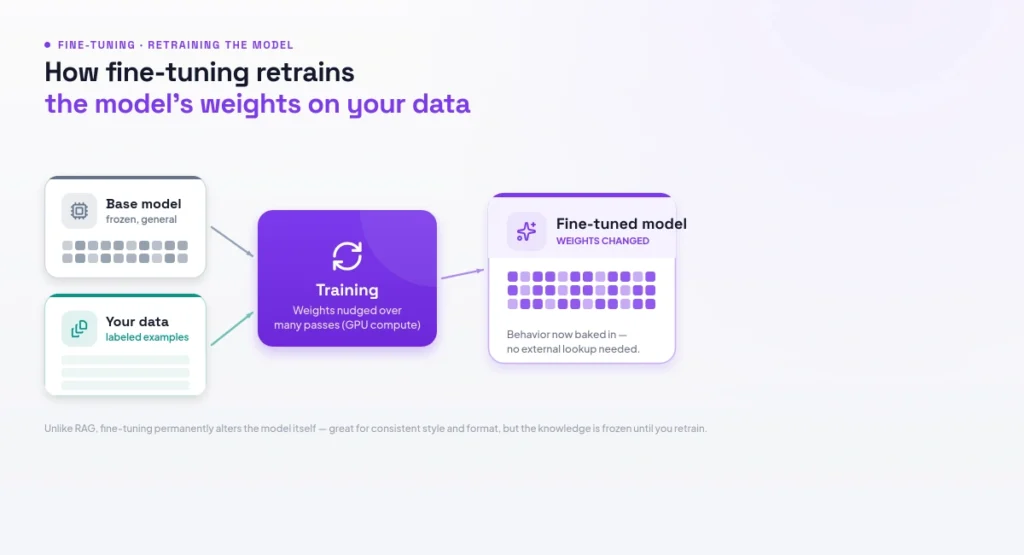
Figure 3: How fine-tuning retrains the model’s weights on your data
4. RAG vs Fine-Tuning: Head-to-Head
The table below compares the two approaches across the factors that matter most in practice.
| Factor | RAG | Fine-Tuning |
|---|---|---|
| Best for | Fresh, changing facts | Consistent style, format, behavior |
| How it works | Looks up external data at query time | Retrains the model’s weights |
| Freshness | Always current (update the data) | Stale until retrained |
| Upfront cost | Lower | Higher (training compute) |
| Hallucinations | Reduced via grounding | Not directly addressed |
| Transparency | Can cite sources | Opaque (“baked in”) |
| Main risk | Poor retrieval / bad data | Forgetting, privacy, rigidity |
The pattern is clear: RAG wins on knowledge, freshness, transparency and agility, while fine-tuning wins on consistent behavior and, for narrow high-volume tasks, efficiency at scale. They are not really competing — they’re addressing different failure modes. If your system gives wrong answers because it lacks current facts, that’s a RAG problem. If it gives correctly-informed answers in the wrong format or tone, that’s a fine-tuning problem.
5. When to Use Each (and Hybrid)
Use RAG when your failure mode is missing or stale facts — knowledge bases, support docs, product catalogs, anything that changes often. Use fine-tuning when your failure mode is behavior inconsistency — wrong format, unstable tone, weak classification, or poor policy adherence. A simple diagnostic: ask whether your problem is “the model doesn’t know X” (RAG) or “the model doesn’t behave like Y” (fine-tuning).
In 2026, the practical default for production-grade quality is hybrid: retrieval for facts, fine-tuning for style, policy and decision behavior. That said, RAG alone remains the most common production choice — around 51% of enterprise deployments use it — precisely because it offers agility and transparency with far less complexity. Hybrid systems are powerful but demand both ML and data-engineering skills and introduce more points of failure, so they’re worth it only when you have the maturity to support them. The models and APIs behind these systems are covered in our guides to Claude AI and the best AI API.
A concrete example shows how the pieces fit. Imagine a customer-support assistant for a software company. The facts it needs — current pricing, the latest feature list, open known issues — change constantly, so those belong in a RAG layer that pulls from live documentation. But the way it should respond — always polite, always in the company’s voice, always escalating billing questions to a human, always answering in a fixed structure — is stable, so that behavior is a strong candidate for fine-tuning. Built this way, the assistant is both up to date and reliably on-brand, and each layer can be improved independently: update the docs without retraining, or refine the behavior without touching the knowledge base. That separation of concerns is exactly why hybrid wins for serious production systems.
| 💡 Pro Tip Before reaching for RAG or fine-tuning, try the cheapest option first: strong prompt engineering, and — if your knowledge base is small — simply pasting it into the model’s context with prompt caching. Many “we need to fine-tune” problems are solved by a better prompt or full-context approach, saving weeks of training work. Escalate to RAG or fine-tuning only when the simpler methods genuinely fall short. |
6. How to Choose the Right Approach
Three factors should drive the decision: knowledge volatility (how often your information changes), query scale (how many requests you handle), and team capability (your ML and data-engineering maturity). Fast-changing knowledge points to RAG; stable, high-volume narrow tasks can justify fine-tuning; and a strong team with both skill sets can run hybrid. If you lack ML expertise, RAG is almost always the safer, faster path.
A practical sequence works for most teams: start with prompt engineering; if you need current or proprietary facts, add RAG; if you still see behavior or format inconsistencies, add fine-tuning on top; and only build a full hybrid when the payoff clearly justifies the added complexity. Avoid the common mistake of burning months on an expensive training run for a problem that was really a retrieval pipeline. Whatever you choose, measure results continuously — and remember that both approaches are means to the same end of making the best AI tools for business genuinely useful for your specific needs.
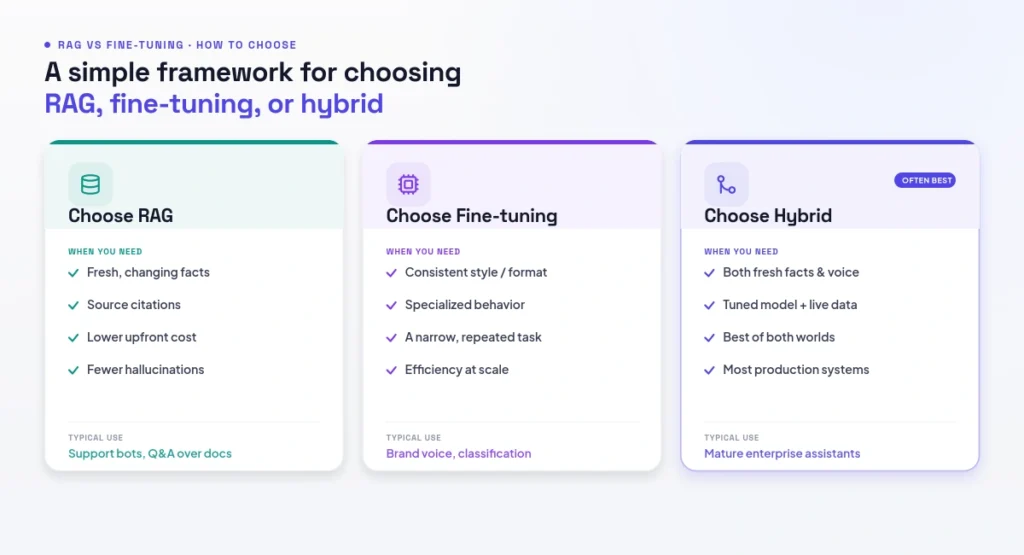
Figure 4: A simple framework for choosing RAG, fine-tuning, or hybrid
| ⚠️ Important Don’t fine-tune to add knowledge that changes — it’s a common, expensive mistake. Fine-tuning bakes information into the weights, so the moment your facts change you must retrain. For anything volatile (prices, policies, inventory, news), use RAG instead. Reserve fine-tuning for stable behavior, and keep knowledge in a retrieval layer you can update instantly. |
7. Frequently Asked Questions
What is the difference between fine-tuning and RAG?
RAG connects an LLM to an external knowledge base so it retrieves relevant facts at query time, without changing the model. Fine-tuning retrains the model’s weights on your data, encoding behavior into the model itself. RAG is best for fresh, changing knowledge; fine-tuning is best for consistent style, format and behavior.
Is RAG better than fine-tuning?
Neither is universally better — they solve different problems. RAG wins for fresh facts, transparency and agility, and is the more common production choice (~51% of enterprise deployments). Fine-tuning wins for consistent behavior and high-volume narrow tasks. In 2026, hybrid systems combining both are the production default.
When should I use RAG instead of fine-tuning?
Use RAG when your problem is missing or stale facts — your model doesn’t know current or proprietary information. RAG lets you update knowledge instantly by changing the documents, keeps answers current, cites sources, and reduces hallucinations. It’s also lower-cost and easier to maintain than fine-tuning for changing knowledge.
When should I fine-tune a model?
Fine-tune when your failure mode is behavior inconsistency — wrong format, unstable tone, weak classification, or poor policy adherence — and the desired behavior is stable. It’s also efficient for high-volume narrow tasks once training cost is amortized. Avoid fine-tuning for fast-changing knowledge, where it forces constant retraining.
Does RAG reduce hallucinations?
Yes. By grounding the model’s answers in retrieved, trusted documents rather than its training memory, RAG reduces hallucination rates by roughly 30–70%. It doesn’t eliminate them — poor retrieval or stale data can still cause errors — so the best results come from RAG plus good data governance and verification.
Can I use both fine-tuning and RAG together?
Yes, and in 2026 hybrid systems are the practical default for production quality: use retrieval for facts and fine-tuning for style, policy and decision behavior. The trade-off is complexity — hybrid needs both ML and data-engineering skills and adds points of failure — so it’s worth it mainly for mature teams.
Which is cheaper, RAG or fine-tuning?
RAG usually has lower upfront and ongoing costs for changing knowledge, since you avoid training runs and just update the data. Fine-tuning has higher upfront training and maintenance cost, but can be cheaper per query for high-volume narrow tasks once that cost is amortized. For most teams starting out, RAG is the more cost-effective path.
Should I fine-tune or just use a better prompt?
Try the prompt first. Strong prompt engineering — and, for small knowledge bases, simply providing the content in context with prompt caching — solves many problems people assume require fine-tuning, at a fraction of the cost and time. Escalate to RAG or fine-tuning only when simpler methods genuinely fall short.
8. Conclusion & Key Takeaways
Fine-tuning and RAG aren’t rivals — they’re different tools for different jobs. RAG keeps your system truthful by retrieving fresh, specific facts at query time; fine-tuning makes it consistent by encoding stable behavior into the model. RAG is the agile, transparent default and the more common production choice, while fine-tuning excels at reliable style and behavior. In 2026, hybrid systems that put knowledge in retrieval and behavior in fine-tuning are the production standard — but the smart path starts with prompting, adds RAG for facts, and reaches for fine-tuning only when behavior inconsistencies remain. To go deeper, see our pillar on the best AI models and the guide to AI hallucinations.
- RAG retrieves fresh facts at query time; fine-tuning bakes stable behavior into the model.
- The rule: RAG keeps you truthful, fine-tuning keeps you consistent.
- RAG is the agile default (~51% of enterprise use) and cuts hallucinations 30–70%; fine-tuning wins on consistent behavior.
- Choose by knowledge volatility, query scale and team capability — hybrid is the 2026 production standard.
- Start with prompting, add RAG for facts, fine-tune only for remaining behavior gaps.
Stop asking “RAG or fine-tuning?” and start asking where your intelligence should live. Put changing knowledge in retrieval, stable behavior in the model, lead with a good prompt — and you’ll build AI that’s both truthful and consistent.

4 Comments
Pingback: What Are AI Hallucinations? Complete Guide 2026 | TechieHub
Thanks for writing this — CV Builder Free at has been useful for similar workflows. CV Builder Free
Pingback: Best AI Models 2026: GPT-5.5 vs Claude vs Gemini vs DeepSeek
Pingback: What is Prompt Engineering? A Complete Beginner Guide