


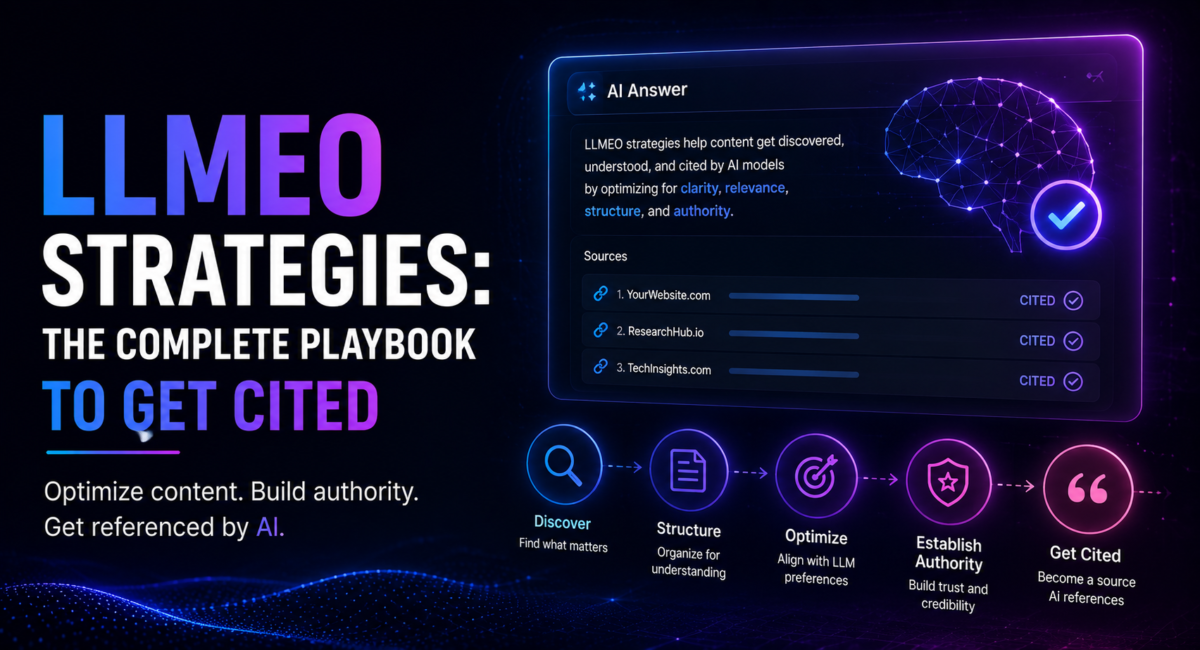
A practical LLMEO playbook — the five core strategies to get your content cited and recommended by ChatGPT, Claude, Gemini and Perplexity, from technical setup to content structure, authority and freshness.
| +40% Visibility from Citing Sources | ~9x Higher AI-Visitor Conversion | 86% Commercial Queries Trigger AI | 5 Core LLMEO Strategies | 5+ AI Crawlers to Allow |
| Quick answer: The core LLMEO strategies are: allow AI crawlers and add an llms.txt file, optimize around real questions instead of keywords, structure every page for extraction with answer-first paragraphs and FAQs, build authority with cited sources and original data, and keep content fresh. Citing sources alone can lift your AI visibility by up to 40%. |
Key Takeaways
- The five core LLMEO strategies: technical access, question-based content, extraction-ready structure, cited authority, and freshness.
- Allow AI bots (GPTBot, PerplexityBot, ClaudeBot, OAI-SearchBot) — a blocked bot makes you invisible to that engine regardless of content quality.
- Optimize around the specific questions customers ask, answer them in the first sentence, and make each passage self-contained (the “Island Test”).
- Citing sources lifts visibility ~40% (Princeton); earned media and co-citation across trusted sites often beat pure technical SEO.
Table of Contents
1. LLMEO (Large Language Model Engine Optimization)
LLMEO (Large Language Model Engine Optimization) is the practice of optimizing your content so AI models like ChatGPT, Claude, and Gemini mention and recommend your brand in their answers. While traditional SEO targets Google rankings, LLMEO targets the AI-generated responses millions of people now trust for decisions.
2. What Are LLMEO Strategies?
LLMEO strategies are the concrete tactics that get your content discovered, cited and recommended by large language models like ChatGPT, Claude, Gemini and Perplexity. Where our LLMEO guide explains how LLMs retrieve and choose sources, this is the execution playbook — the specific, repeatable moves that turn that understanding into citations. They fall into five reinforcing strategies, and the order matters: skip the foundation and the rest cannot deliver.
The stakes are concrete. A growing, irreversible share of searches now end with an AI-generated answer rather than a click, and the sites those answers cite capture an enormously valuable new form of visibility — while uncited sites become invisible to an audience that grows every month. That visibility converts, too: AI-referred traffic has been reported to convert several times better than traditional organic search, because users arrive pre-qualified by the AI’s recommendation. These strategies layer on top of solid traditional SEO, which is why the smart sequence is to get SEO right first, then add LLMEO.
Everything here supports the broader discipline of generative engine optimization and overlaps with answer engine optimization. The difference is focus: this guide is the hands-on, do-this-next checklist.
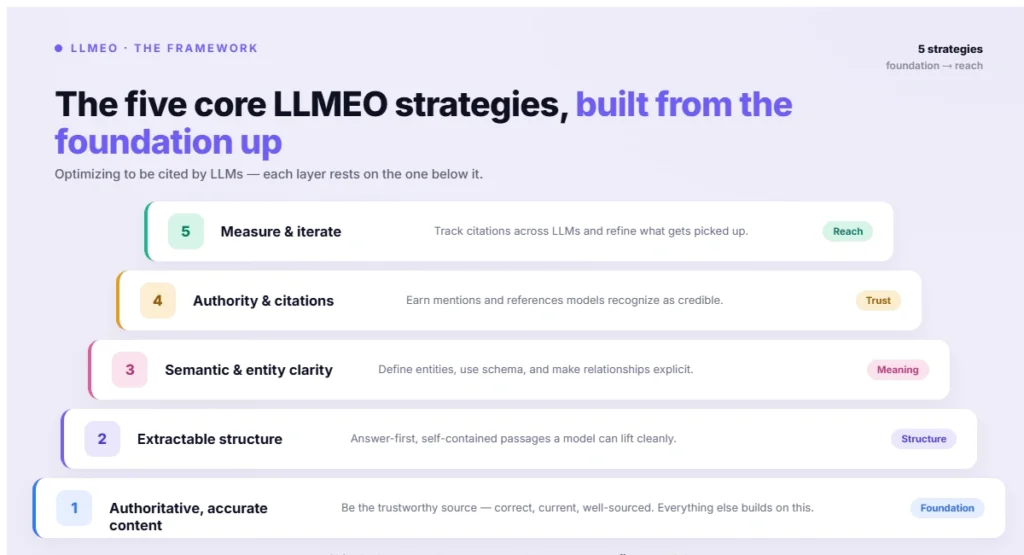
Figure 2: The five core LLMEO strategies, built from the foundation up
3.LLMEO vs GEO vs AEO: What’s the Difference?
These three terms overlap, but they target different systems. Here’s the quick comparison:
| LLMEO | GEO | AEO | |
|---|---|---|---|
| Full form | Large Language Model Engine Optimization | Generative Engine Optimization | Answer Engine Optimization |
| What it targets | AI models themselves (ChatGPT, Claude, Gemini) | AI-powered search (Google AI Overviews, Perplexity) | Answer boxes (featured snippets, voice, People Also Ask) |
| Goal | Get the model to mention/recommend your brand in its answers | Get cited in AI-generated search results | Win the direct-answer position on Google |
| How it works | Influences training data and retrieval layers | Optimizes for live web results generative engines pull from | Structures content for easy answer extraction |
| Where you appear | Inside the chatbot’s response | In AI search summaries with citations | Position-zero snippet / voice answer |
| Competition level (2026) | 🟢 Low — biggest opportunity | 🟡 Growing fast | 🔴 Mature/crowded |
| Best first step | Our LLMEO strategies below | 90-day GEO roadmap → techiehub.blog/generative-engine-optimization/ | Best AEO tools → techiehub.blog/best-answer-engine-optimization-tools/ |
Think of it as layers: AEO wins the answer box, GEO wins AI search results, and LLMEO wins the model’s memory itself. Most brands eventually need all three — but LLMEO is where competition is still thin, which makes it the biggest opportunity in 2026.
4. Strategy 1: Win the Technical Foundation
LLMs cannot cite what they cannot reach, so technical access comes first. The single most important — and most overlooked — step is your robots.txt: explicitly allow the major AI crawlers, including GPTBot, OAI-SearchBot, PerplexityBot, ClaudeBot and Applebot. This is a binary signal: if a bot is blocked, you are invisible to that engine no matter how good your content is. Next, add an llms.txt file — a simple “handshake with the AI web” that tells models who you are, what you know and where to find your key content; every credible site should now have one.
Two more technical moves complete the foundation. Serve your content as clean, server-rendered HTML, because many AI crawlers do not execute JavaScript and will miss anything that loads only after scripts run. And implement IndexNow so new and updated pages reach search indexes within minutes — important because some assistants’ live browsing runs on those indexes. Add schema markup (Article, FAQPage, Organization) on top, and you have made your site fully legible to the systems that decide what to cite.
It is worth auditing this foundation before investing in content, because a single misconfiguration can silently waste everything above it. A surprising number of sites discover that a blanket robots.txt rule, a security plugin, or a CDN setting is quietly blocking AI crawlers — meaning their excellent content is invisible to ChatGPT or Perplexity no matter how well it is written. Spend an hour confirming each major bot is allowed, that your most important pages render without JavaScript, and that your sitemap and llms.txt are current. This unglamorous checkup is the cheapest, highest-return work in all of LLMEO: it costs almost nothing and unlocks every other strategy you are about to apply.
5. Strategy 2: Optimize Around Questions
Traditional SEO optimizes around keywords — the short phrases people type into a search box. LLMEO optimizes around questions, because that is how people talk to AI: they describe a situation or ask a full question in natural language, and the AI looks for sources that answer it completely, directly and credibly. So the unit of strategy shifts from keyword to question.
There is a simple exercise to apply before writing any article. Write down the five most specific questions a real customer would ask about the topic; make sure each is explicitly answered in the article, not merely implied; and use the question itself, or a close variant, as a heading. This does three things at once: it matches how users phrase prompts, it gives the model clean question-and-answer pairs to extract, and it surfaces gaps where your content only hints at an answer. Building content around the real questions in your category — across an interlinked cluster of pages — is one of the highest-leverage LLMEO moves there is.
Where do you find those real questions? Mine them rather than guess. Your sales and support teams hear the exact phrasing customers use every day; “People Also Ask” boxes and autocomplete reveal adjacent queries; and running a few prompts in ChatGPT and Perplexity shows how the engines themselves frame the topic. Map those questions to the stages of the buyer’s journey — early definitional questions, mid-funnel comparisons, late-stage decision questions — and make sure your content cluster answers each stage. Coverage breadth matters because LLMs reward sources that comprehensively address a topic, so a cluster that answers the whole question landscape will out-cite a single article every time.
6. Strategy 3: Structure Every Page for Extraction
LLMs scan and extract; they do not read top to bottom. So structure decides whether your great answer ever gets pulled. Three habits matter most. First, answer first: resolve each question in the opening sentence or two, then expand — models lift that direct answer into their responses. Second, use FAQ sections and clear H2/H3 headings, which give models clean, self-contained units to quote. Third, apply the “Island Test”: every paragraph should make sense on its own, as if it were the only thing the model retrieved.
The Island Test is the most practical structural fix. Review your top pages and rewrite any paragraph that opens with “It,” “This,” or “They” — vague references that only make sense in context — so each passage names its subject explicitly and stands alone. Because a model may retrieve a single paragraph out of context, self-contained writing dramatically raises the odds it gets cited correctly. Combined with answer-first openings and FAQ structure, this turns a page that merely contains the answer into one engines can confidently extract.
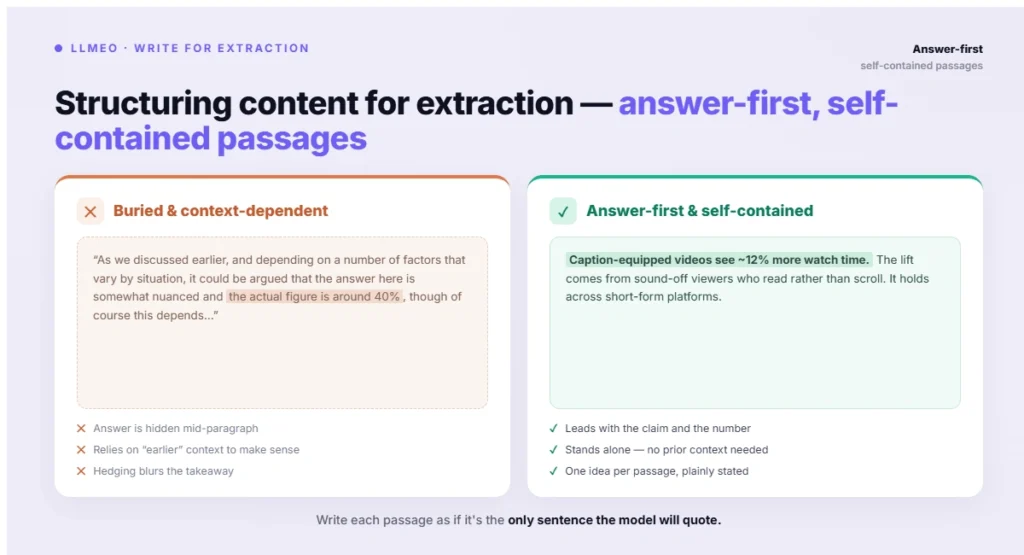
Figure 3: Structuring content for extraction — answer-first, self-contained passages
| 💡 Pro Tip Run the “Island Test” on your ten most important pages this week: find every paragraph starting with “It,” “This,” or “They” and rewrite it to name its subject. It is a fast, high-impact edit — self-contained passages are far more likely to be retrieved and cited accurately when a model pulls just one chunk of your page. |
7. Strategy 4: Build Authority & Earn Citations
Structure makes you extractable; authority makes you trusted. Models favor content that demonstrates expertise and is corroborated elsewhere. On-page, the highest-leverage move is citing named sources for every statistic and claim — peer-reviewed research found this lifts AI visibility by up to 40% — alongside original data, frameworks and expert quotes that give a model unique, attributable material. Show clear author credentials and strong expertise signals (the E-E-A-T principles) so models and their training pipelines recognize you as a credible source.
Off-page is where many teams under-invest, yet it is decisive. Because models cross-reference, being mentioned and accurately described across many independent, trusted sources — reviews, comparisons, reputable publications, expert roundups — is among the strongest signals you can build, and earned media often beats pure technical SEO for AI citations. Aim for co-citation across five or more independent sites for your key topics. A practical way to earn this is to become genuinely quotable: publish original research, offer expert commentary to journalists, get listed in credible comparison roundups, and earn reviews on the platforms your category trusts. Together, on-page evidence and off-page corroboration tell a model that you are not just extractable, but worth quoting. This authority layer connects directly to the model behavior covered in our best AI models guide.
8. Strategy 5: Freshness, Platform Tactics & Measurement
The final strategy is to stay current and platform-aware, then measure. LLMs with web access heavily weight freshness, so update data, examples and pages on a regular cadence — outdated statistics get deprioritized, especially on freshness-focused engines. Tactics also vary by platform: Perplexity always performs a live web search and values recency most, ChatGPT can answer from training data or browse, and each engine cites differently. Optimize for the platforms your audience actually uses rather than chasing all of them equally.
Finally, treat LLMEO as a measured loop. Because LLMs are non-deterministic, track share of voice — how often you appear across relevant prompts — rather than a ranking position, watch which pages get cited, and run your key prompts manually each month. Specialized platforms automate this; see our guides to the best AI search monitoring tools and broader answer engine optimization tools. Make one improvement, measure whether your mention rate rises, and iterate — the same disciplined loop that runs through any good AI tools for business program.
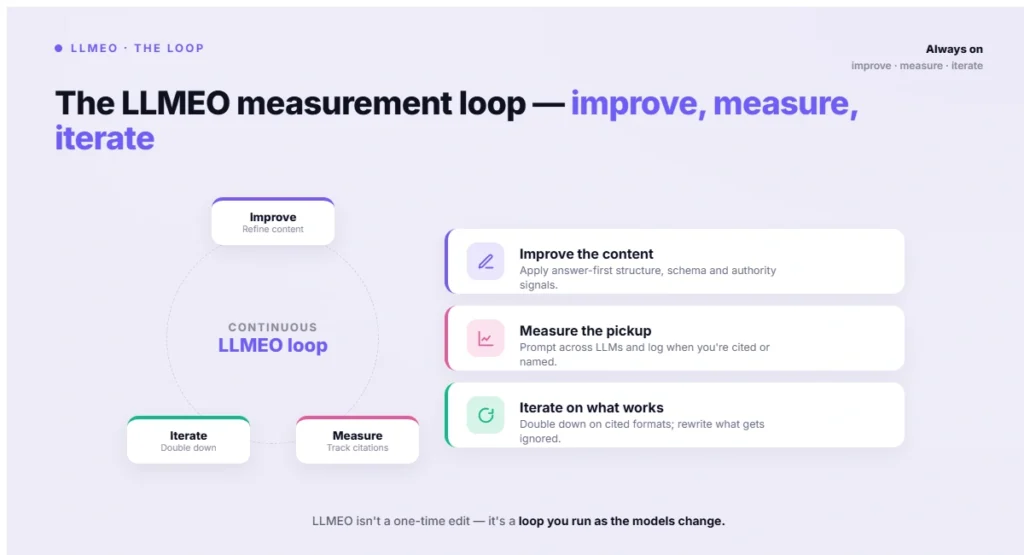
Figure 4: The LLMEO measurement loop — improve, measure, iterate
| ⚠️ Important Do not chase shortcuts or “inject me into ChatGPT” gimmicks — models increasingly detect and discount manipulation, and the risk to your credibility is real. The honest rule: if a tactic would not help a human reader, do not use it for LLMs. Durable LLMEO comes from genuinely being the clearest, most authoritative, most current answer. |
9. Frequently Asked Questions
What are the best LLMEO strategies?
The five core strategies are: win the technical foundation (allow AI crawlers, add llms.txt, serve clean HTML), optimize around real questions, structure every page for extraction with answer-first paragraphs and FAQs, build authority with cited sources and original data, and keep content fresh. They reinforce each other and build on solid traditional SEO.
How do I get my content cited by ChatGPT and Perplexity?
Allow AI crawlers in robots.txt, answer real questions directly in the first sentence, structure content so passages are self-contained, cite named sources and add original data, earn mentions across trusted sites, and keep pages fresh. Because Perplexity and ChatGPT search the live web, strong traditional SEO also feeds your visibility.
Which AI crawlers should I allow in robots.txt?
Allow the major ones: GPTBot and OAI-SearchBot (OpenAI), PerplexityBot, ClaudeBot (Anthropic), Applebot, and Google-Extended. This is binary — if a bot is blocked, you are invisible to that engine no matter how good your content is, so confirm none are accidentally disallowed.
What is the “Island Test” in LLMEO?
The Island Test means every paragraph should make sense on its own, as if it were the only thing a model retrieved. Rewrite passages that start with vague references like “It,” “This,” or “They” to name their subject explicitly. Because models often pull a single chunk out of context, self-contained writing raises your odds of accurate citation.
Does citing sources really improve AI visibility?
Yes. Peer-reviewed research from Princeton and Georgia Tech found that citing sources can lift visibility in AI answers by up to 40%, one of the most effective on-page tactics. Adding original data, statistics with named sources, and expert quotes gives models credible, attributable material they prefer to cite.
What is an llms.txt file?
An llms.txt file is a simple text file — a “handshake with the AI web” — that tells language models who you are, what your site covers, and where to find your most important content. It is becoming a standard alongside robots.txt and sitemaps, and adding one is a quick, low-effort LLMEO foundation step.
Is LLMEO different for each AI platform?
Somewhat. The core strategies transfer, but tactics vary: Perplexity always searches the live web and prizes freshness, ChatGPT blends training data with browsing, and each engine cites differently and shares only a fraction of its sources with others. Optimize for the platforms your audience uses rather than treating them as identical.
How do I measure whether my LLMEO strategies are working?
Track share of voice — how often your brand appears across relevant prompts — rather than a ranking position, since LLMs are non-deterministic. Monitor which pages get cited, run your key prompts manually each month, and use specialized AI visibility tools. Make one change, watch whether your mention rate rises, and iterate.
10. Conclusion & Key Takeaways
LLMEO is not magic — it is a disciplined playbook. Win the technical foundation, build content around the real questions your audience asks, structure every page so passages stand alone and get extracted cleanly, back your claims with cited sources and earned authority, and keep everything fresh. Then measure your share of voice and iterate. Done honestly, these five strategies make you the source AI assistants reach for, capturing the high-converting visibility that increasingly defines online discovery. They sit inside the wider generative engine optimization strategy; pair them with our LLMEO and Perplexity SEO guides to round out the picture.
- Build the five strategies in order: technical access, questions, extraction structure, authority, freshness.
- Allow AI crawlers and add llms.txt — a blocked bot makes you invisible regardless of content quality.
- Optimize around real questions and apply the Island Test so every passage is self-contained.
- Cite sources (+40% visibility), add original data, and earn co-citation across trusted sites.
- Stay fresh, optimize per platform, and measure share of voice in a continuous loop.
LLMEO rewards the patient, honest operator: make your site legible, answer real questions, write self-contained passages, earn authority, and stay current. Run the loop, and you become the answer the models trust — and recommend.

9 Comments
Pingback: 12 Best AI Tools for Academic Research 2026: Complete Guide
Pingback: 15 Best AI Sales Forecasting Tools 2026: Complete Guide
Pingback: 20 Best AI Tools for YouTube Automation 2026
Pingback: 15 Best AI Tools for Generating Images for Designer
Pingback: Answer Engine Optimization to Get Cited by AI First
Pingback: Generative Engine Optimization to Dominate AI Search
Pingback: LLMEO: Large Language Model Optimization Explained - Techiehub
Pingback: Best Answer Engine Optimization Tools That Actually Work
Pingback: Perplexity SEO Guide to Rank in AI Powered Search